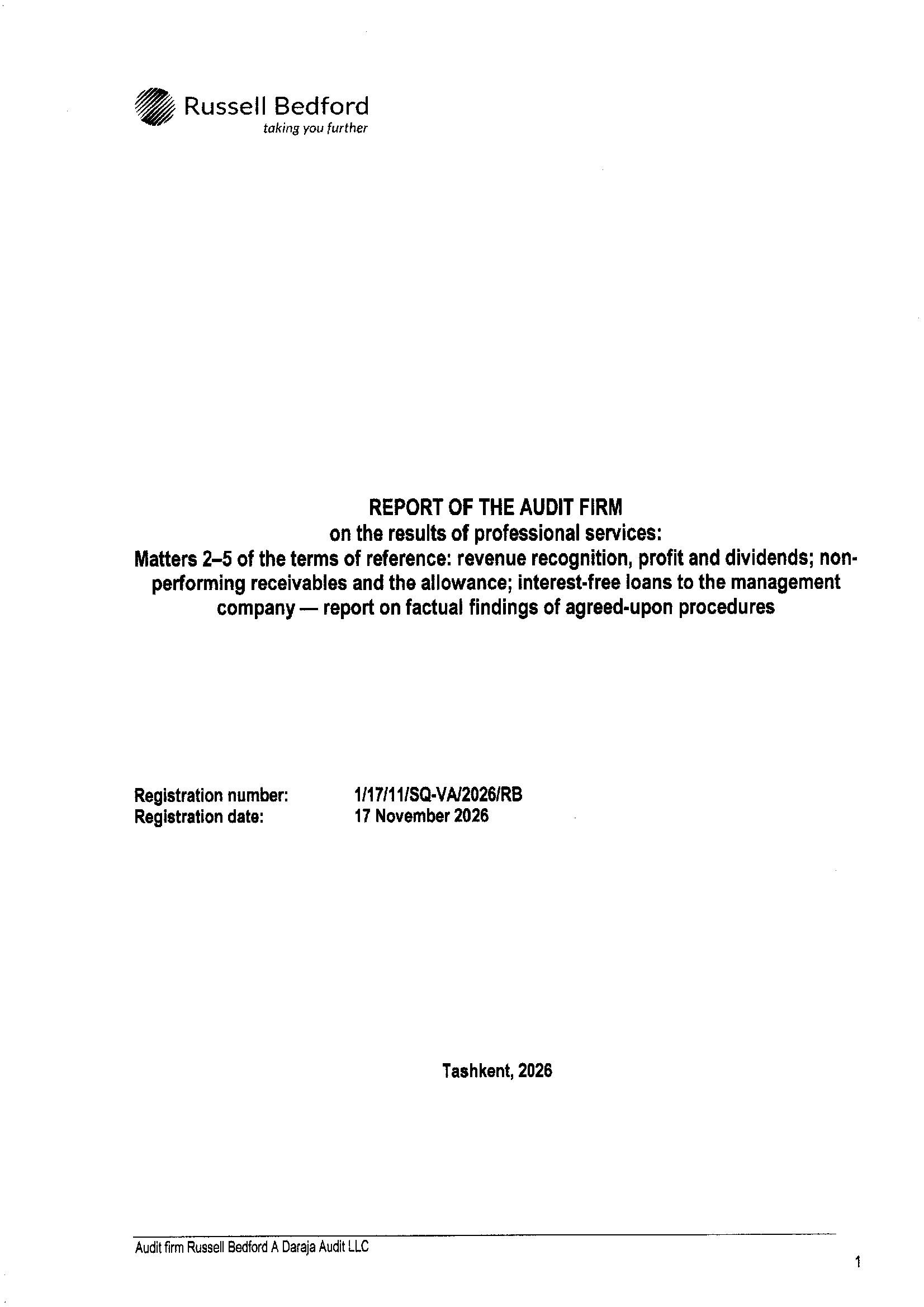
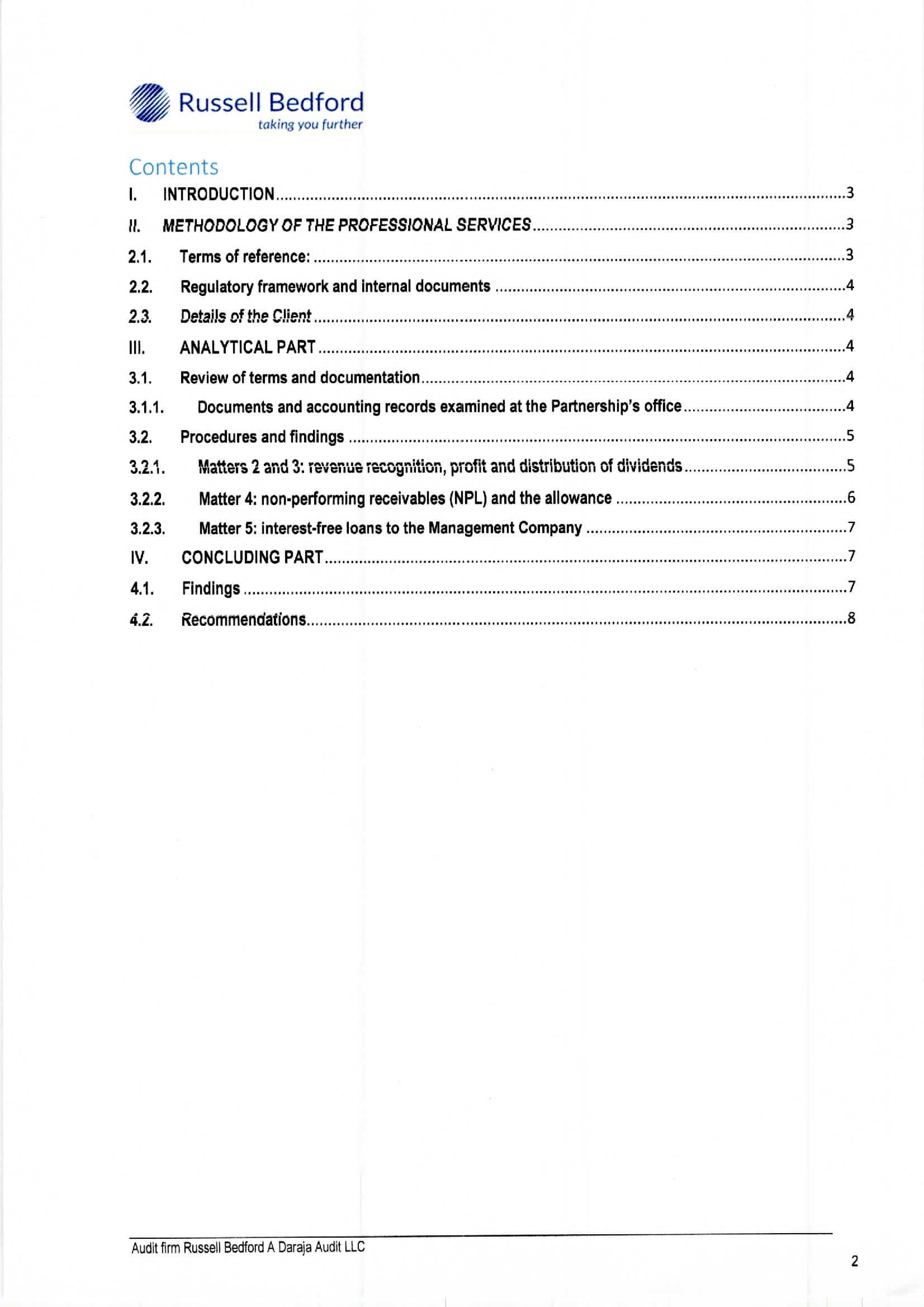
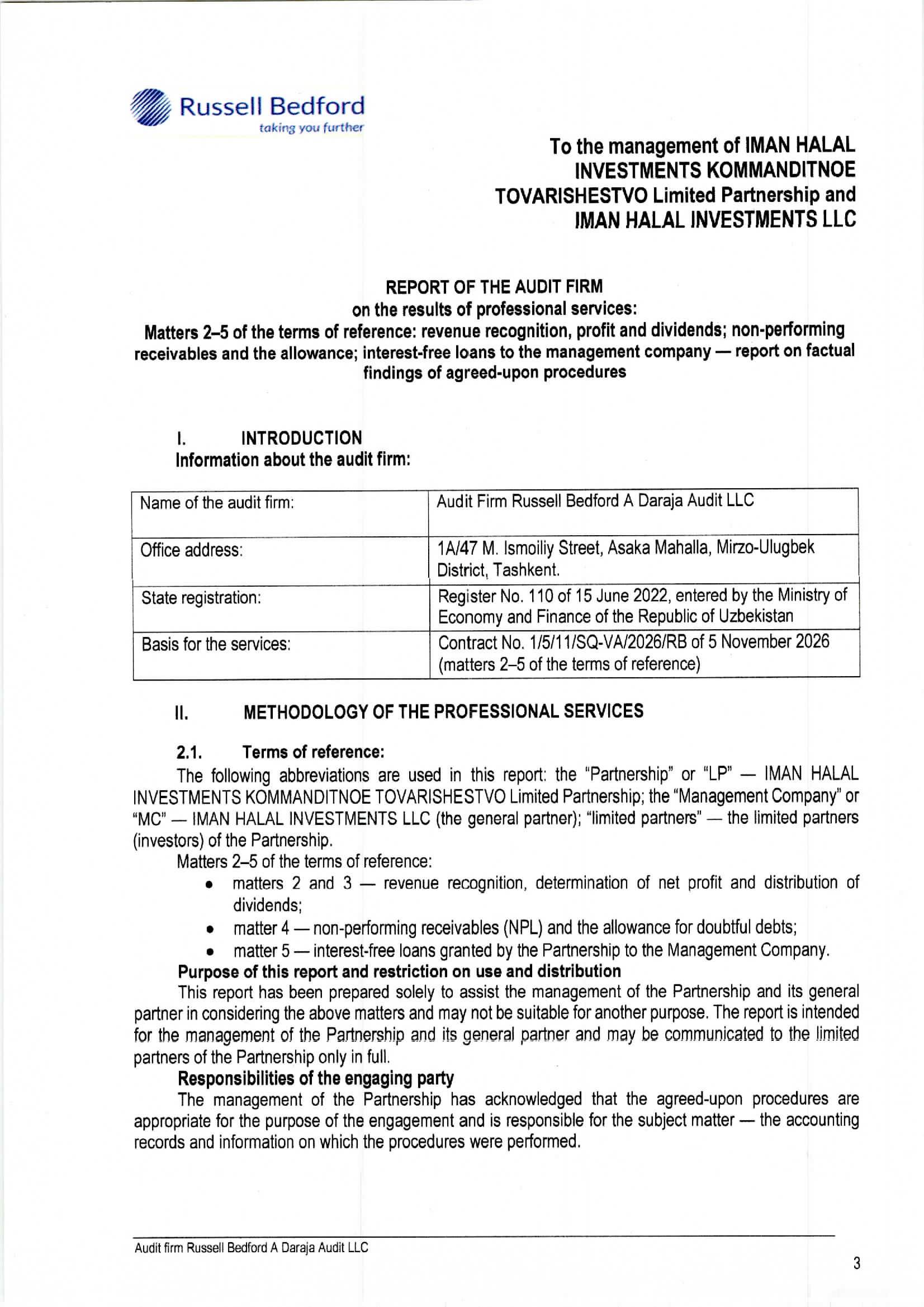
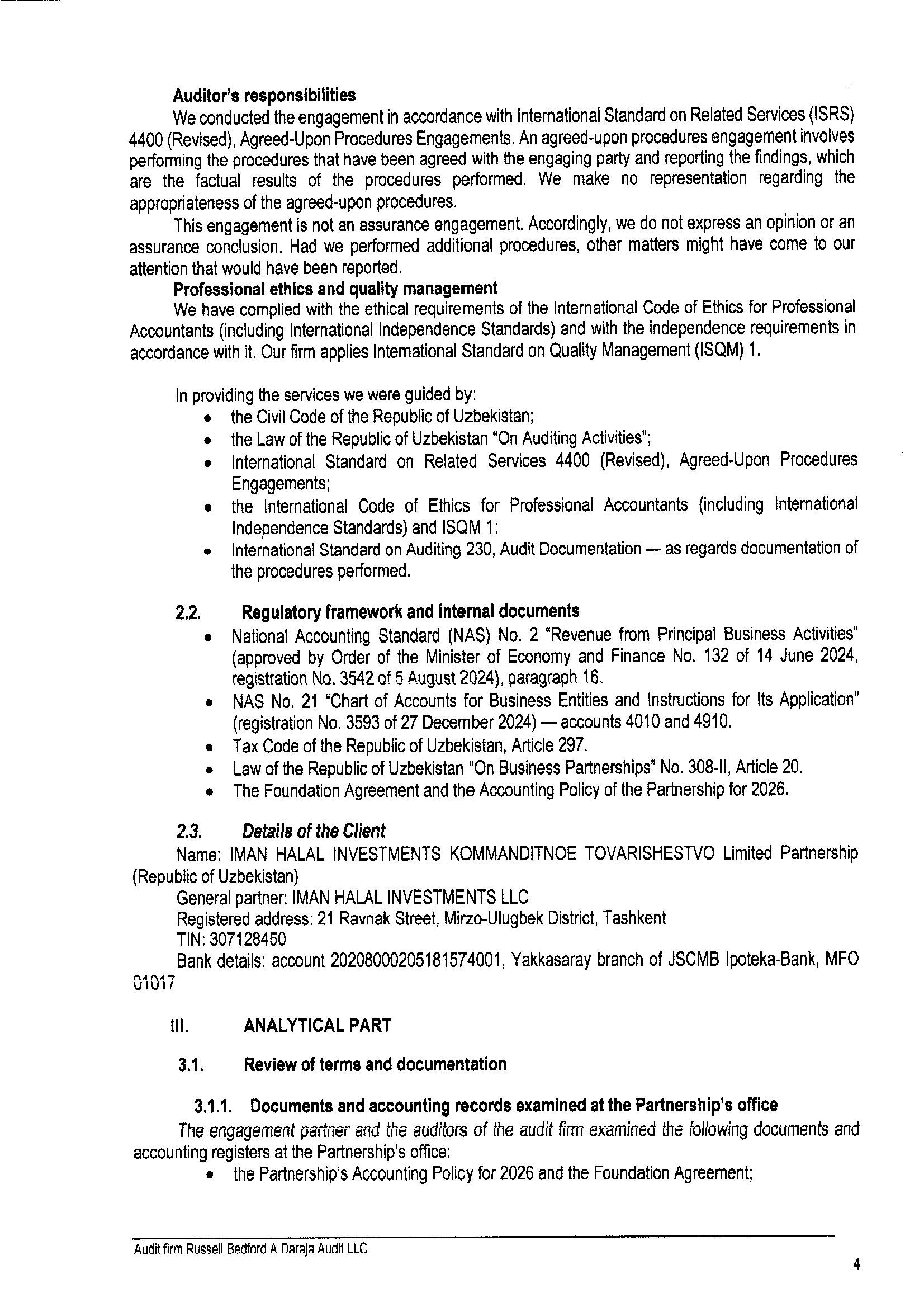
Auditors confirm: IMAN is a profitable company with no shortfall
IMAN held an expert media briefing attended by representatives of leading media outlets, financial analysts, and members of the Supervisory and Shariah boards.
At the meeting, reports from independent international and local audit firms were presented on the results of five specialised reviews (due diligence) covering all the main aspects of the company’s operations:
- Special-purpose financial audit (Financial Due Diligence) — the audit firm Russell Bedford A Daraja Audit (part of the international audit network Russell Bedford, present in 105 countries, one of the top 20 global audit networks, headquartered in London, United Kingdom).
- Tax audit (Tax Due Diligence) — tax consulting and audit specialists of the law firm “Turon Himoyasi”.
- Legal due diligence (Legal Due Diligence) — the international law firm Baker Tilly Tashkent Legal, part of the global Baker Tilly network of independent firms (more than 147 offices worldwide, one of the 10 largest global audit and consulting networks).
- Regulatory review (Regulatory Due Diligence) — the regional law firm Centil Law.
- Shariah audit (Shariah Due Diligence) — the international audit and consulting firm Usmani’s, founded by the family of the world-renowned Islamic jurist Sheikh Muhammad Taqi Usmani.
The meeting reviewed in detail the company’s financial statements, primary documents and contracts. The specialists gave a professional assessment of the claims circulated on social media in recent weeks, and answered journalists’ questions.
1. Special-purpose financial audit: why the claim of a “$20.6 million shortfall” is not true
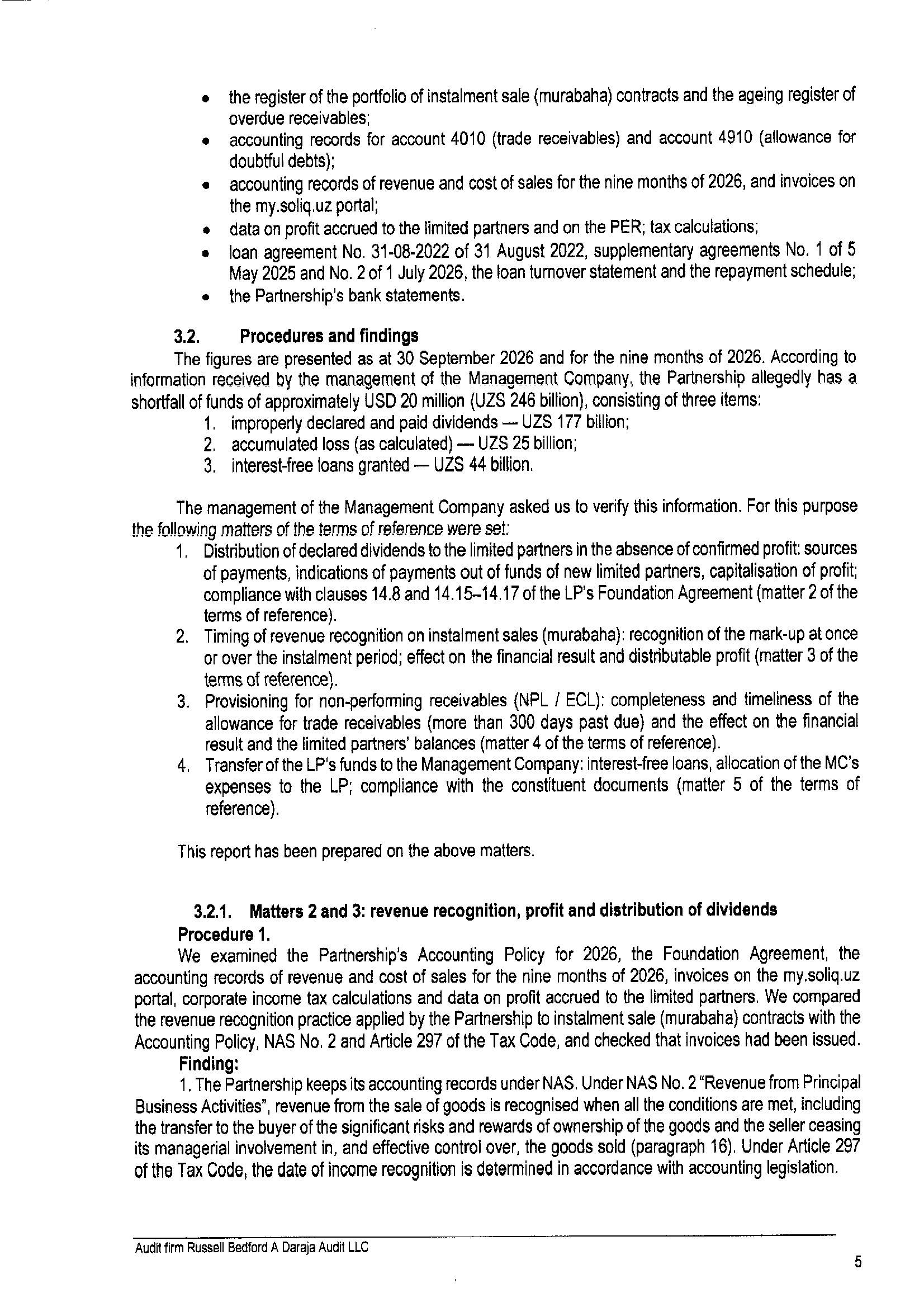
The special-purpose financial audit found that as at 1 October 2026 (for the nine months of 2026) the company’s financial position is stable and its operations are profitable.
| UZS 1,032.6 billion | UZS 82.5 billion | UZS 67.4 billion |
|---|---|---|
| Total revenue for 9 months of 2026 under NAS | Total protective reserves as at 30.09.2026 (58.1 billion for receivables + 24.4 billion PER reserve) | Taxes paid to the budget of Uzbekistan for 2024–2026 (10 months); more than 300 employees |
The audit firm’s report sets out how the inaccurate figure of a supposed “$20.6 million shortfall” circulating on social media appeared: it came from mechanically adding up three economically unrelated indicators without regard to national accounting standards or the reserves already in place.
1.1. Revenue recognition, net profit and dividend payments
The auditors analysed the limited partnership’s (LP) accounting policy for 2026, its founding agreement, the revenue and cost-of-sales registers for 9 months of 2026, the electronic invoices on the government portal my.soliq.uz, the profit tax calculations and the statements of income accrued to investors.
The partnership keeps its accounts in full compliance with the National Accounting Standards of the Republic of Uzbekistan (NAS). Under NAS No. 2 “Income from core business activities” (paras 12–13) and Article 297 of the Tax Code of Uzbekistan, revenue from the sale of goods is recognised when control of the goods passes to the buyer and the electronic invoice is issued through my.soliq.uz.
The estimated “loss of UZS 25 billion” mentioned on social media turned out to be the result of a methodological error: the incorrect calculation wrote off the cost of goods sold and other expenses at once (in a single amount on the date of sale), in full on the invoice date, while income was counted only partly — as monthly instalment payments actually came in (the cash method).
With accounts kept under NAS, for the nine months of 2026 the partnership shows a steady net profit and pays its profit tax regularly.
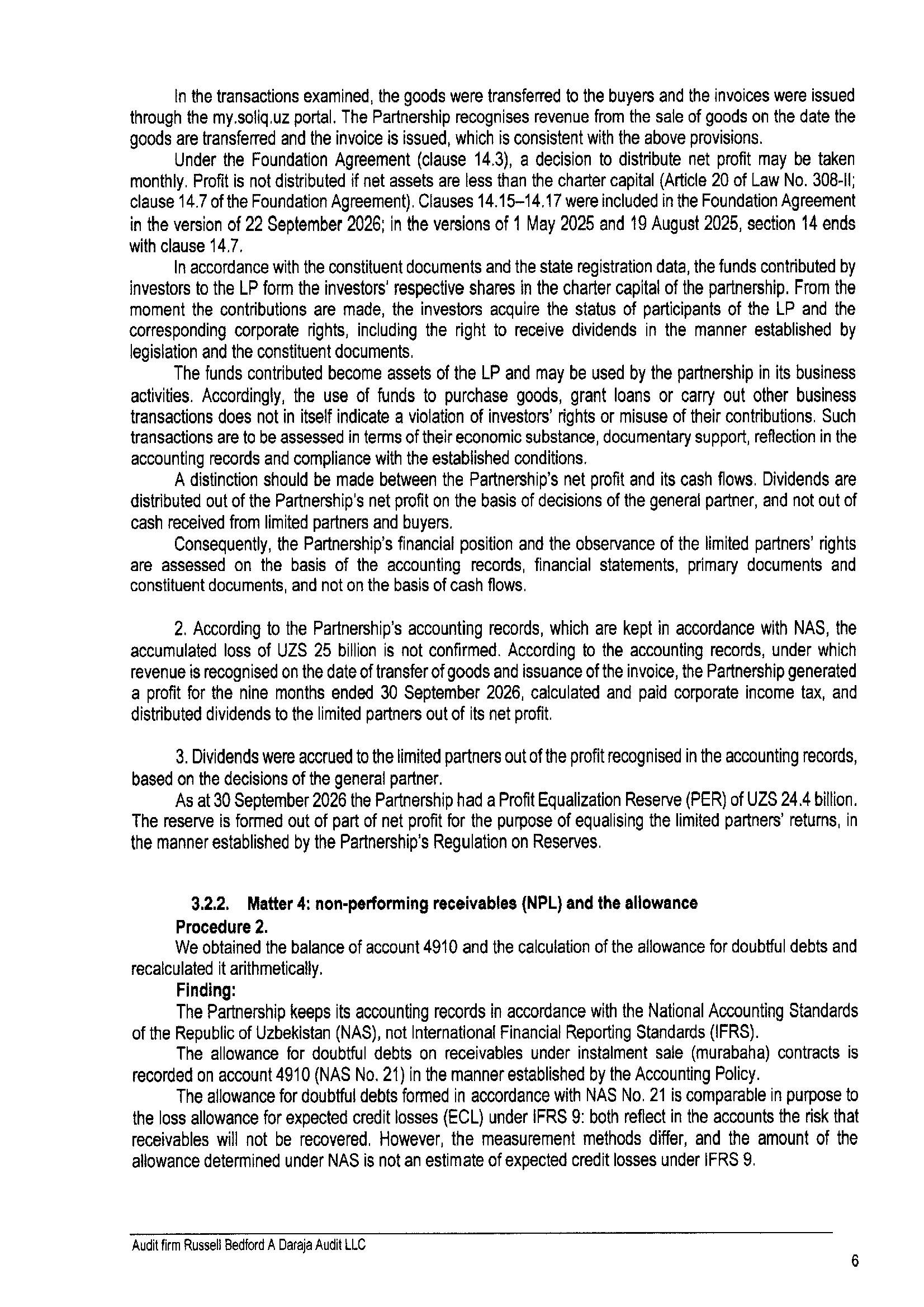
The auditors stressed the need to distinguish the statement of financial results (income, expenses, net profit) from the cash flow statement (inflows (receipts) and outflows (payments)). Under the founding agreement (paras 14.3, 14.7) and Article 20 of the Law of Uzbekistan “On Business Partnerships” No. 308-II, dividends are paid only out of net profit earned, and cannot be paid if net assets are below the charter fund. In addition, as at 30 September 2026 the partnership has set aside a dedicated profit equalisation reserve (PER — Profit Equalization Reserve) of UZS 24.4 billion on current instalment contracts.
1.2. Managing overdue receivables (NPL) and reserve coverage
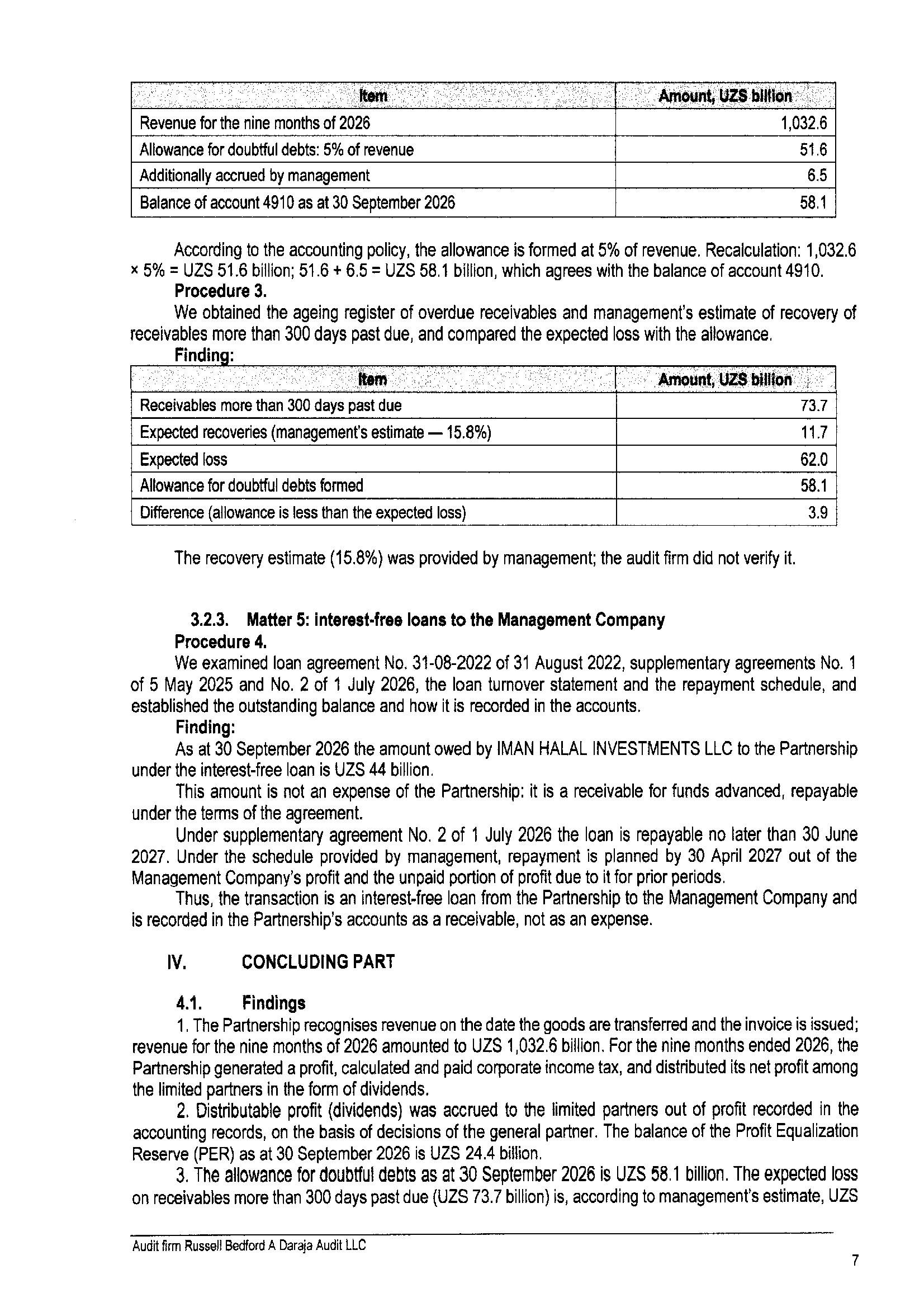
In reviewing receivables, the auditors examined accounts 4010 and 4910 and the register of contracts by payment due date as at 30.09.2026, and independently recalculated the reserves. The reserve for doubtful debts on murabaha (instalment) contracts is formed under the national standards, NAS No. 21, and in its protective role is similar to the expected credit loss (ECL) allowance under the international standard IFRS 9.
With the partnership’s total revenue for 9 months of 2026 at UZS 1,032.6 billion, the planned reserve under the accounting policy (5% of revenue) is UZS 51.6 billion. The actual balance of the reserve on account 4910 as at 30.09.2026 reached UZS 58.1 billion — management conservatively added a further UZS 6.5 billion.
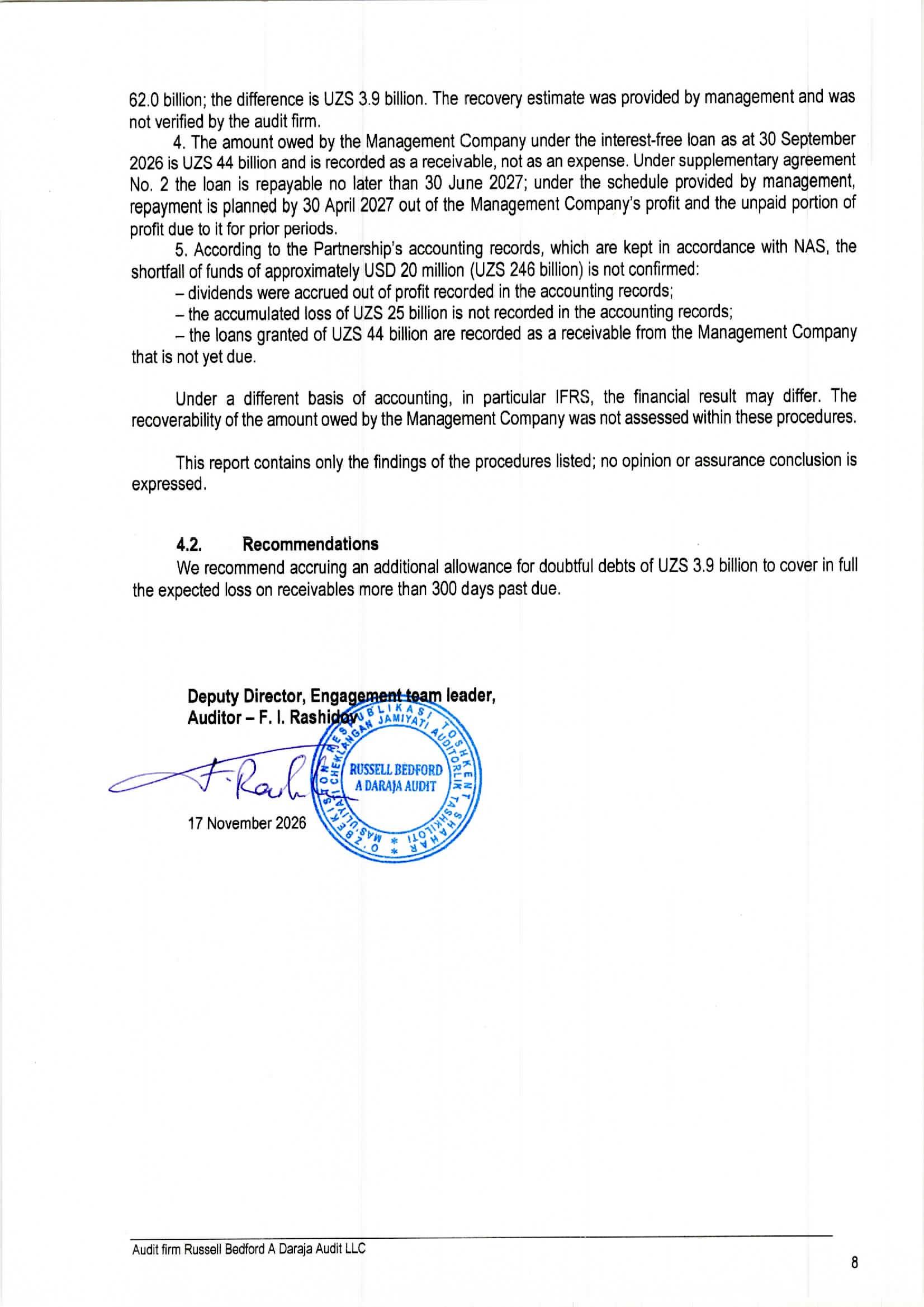
Receivables more than 300 days overdue stood at UZS 73.7 billion at the reporting date. Taking into account the confirmed historical recovery rate of 15.8% at this level of delinquency, or UZS 11.7 billion of expected collections, the estimated credit risk (risk of default) is about UZS 62.0 billion. The auditors recommended adding only UZS 3.9 billion of extra buffer as planned.
1.3. Interest-free loans to the management company for IT infrastructure
The auditors also checked the UZS 44 billion provided by the limited partnership to the management company, Iman Halal Investments LLC, as at 30.09.2026. It was confirmed that this amount is not an expense or an irrecoverable write-off — in the LP’s accounts it is correctly recorded as a receivable to be repaid under interest-free loan agreements.
Repayment of this receivable is set by an approved schedule over 6 months, from the management company’s own profit and by offsetting the LP’s obligations to the management company for unpaid management fees from past periods.
1.4. Corporate instalment deals and the results of the tax audit (Tax DD)
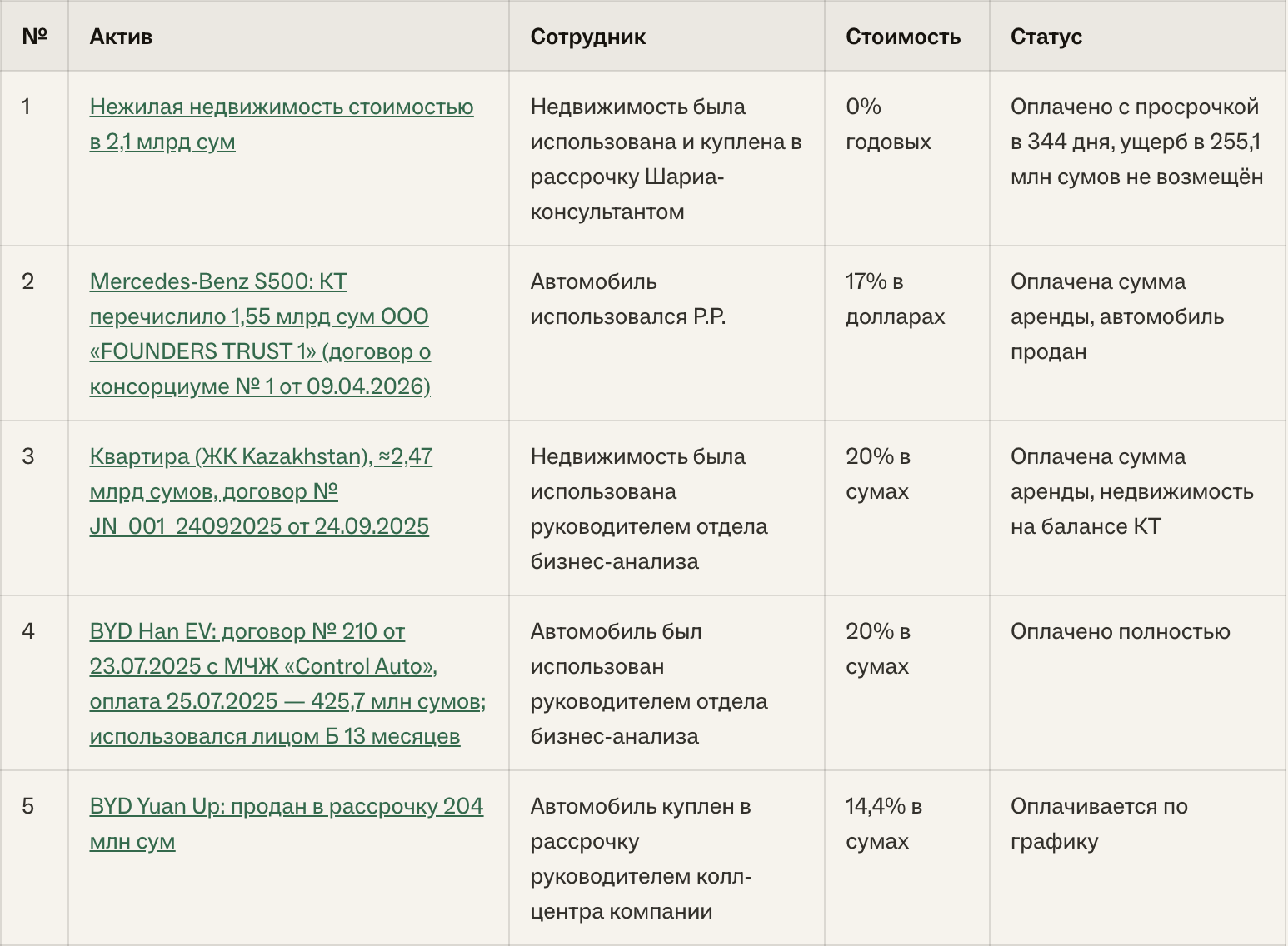
The management of the limited partnership presented a documented report on deals financing assets (vehicles and real estate) in instalments for key employees, under the current business model and HR policy.
Checking the primary contracts and invoices confirmed that the commercial finance lease and instalment deals were made on market terms (from 14.4% to 20% a year in soums and up to 17% in foreign currency terms) and are being repaid strictly on schedule, or have already been fully closed by the sale and payment of the asset without any loss to the partnership. The only exception was a deal to buy residential property in instalments on preferential terms for a former Shariah consultant: because the payment was 344 days late and because of VAT deductions on the transaction, a loss of UZS 255.1 million was recorded. All closing electronic invoices are published for verification on the company’s corporate website.
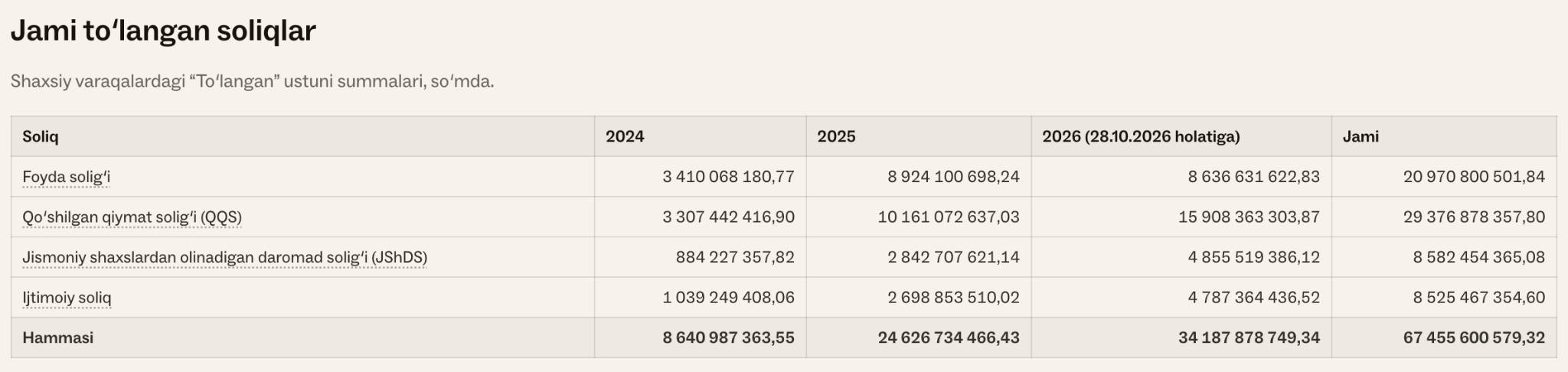
The tax audit (Tax Due Diligence) carried out by the law firm “Turon Himoyasi”, and official reconciliations with the tax authorities of Uzbekistan, confirmed that for 2024, 2025 and 10 months of 2026 the company paid more than UZS 67.4 billion in corporate and payroll taxes to the state budget (the company employs more than 300 people). Officially certified statements from the tax authorities are publicly available on the corporate website.
2. Legal and regulatory review: legal protection for investors and the platform’s status
Rustam Akramov, partner at the international law firm Baker Tilly Tashkent Legal, presented the preliminary findings of the comprehensive legal review of IMAN HALAL INVESTMENTS LLC and the limited partnership IMAN HALAL INVESTMENTS KOMMANDITNOE TOVARISHESTVO for compliance with the laws of the Republic of Uzbekistan.
“At this point, based on the corporate and operational documents we have reviewed, we have no grounds to say that the partnership’s business is a financial pyramid.”
The legal audit highlighted the key legal mechanisms that protect investors’ interests:
- A lawful corporate model: The partnership raises funds only as limited partners’ contributions to its charter capital under Articles 28–31 of the Law of Uzbekistan “On Business Partnerships”. An investor receives not bank interest but a share of real trading profit in proportion to their contribution (Art. 30(1) of the Law; para 22.3 of the founding agreement).
- An outright ban on pyramid payouts: The founding agreement expressly prohibits paying income out of new contributions and guaranteeing a fixed return (paras 14.15–14.17), and distributing profit when net assets are below the charter fund (Art. 20(2) of the Law; para 14.8 of the founding agreement). No signs of offences under Article 188-1 of the Criminal Code of Uzbekistan were found; the company also has every right to defend its business reputation in court and to claim damages under Article 100 of the Civil Code of Uzbekistan.
- Real trading and the NAPP register: The partnership really sells goods in instalments through a network of partner shops, and on 24 September 2026 it was officially entered by the National Agency for Prospective Projects (NAPP) in the Register of Operators of Electronic Trading Platforms (notification No. ETPO-00003).
- Protected intellectual property and transparent payments: The software products IMAN Invest, IMAN Marketplace and IMANUM 5.0 are officially registered with the Ministry of Justice of Uzbekistan in the company’s name (certificates No. DGU 12585, 12561, 68112). All contributions are accepted only from the investor’s own account or card, and payouts go strictly to the investor’s own bank card.
- Tighter internal compliance: Since 22 September 2026 the founding agreement has included rules that prohibit investing the partnership’s funds in projects with below-market returns (para 12.5), limit marketing discounts (para 12.6) and fully prohibit discounts for founders and members of the governing bodies.
Next, on the regulatory review (Regulatory Due Diligence), Diyor Islambekov, head of the regional law firm Centil Law, took the floor. He noted that the company has steadily improved its legal model ever since the first legal opinion (Legal DD) that Centil Law prepared for IMAN in 2021, and that bringing the sector under the supervision of a dedicated state regulator closes the market’s earlier legal gaps.
“The company is now moving under the regulation of the National Agency for Prospective Projects (NAPP) as an investment and trading platform, which benefits the transparency and resilience of the business. Developing infrastructure for secondary trading of shares, publishing regular reports on the corporate website and on the regulator’s platforms, and introducing advanced standards of corporate governance will significantly strengthen the market’s long-term trust in IMAN.”
3. International Shariah audit (Usmani’s and the IMAN Shariah Board)
The briefing paid particular attention to the preliminary results of the independent Shariah audit (Shariah Due Diligence) being carried out by the international audit firm Usmani’s, which checks the company’s operating processes and products against the international standards for Islamic financial institutions (AAOIFI). The foreign experts’ findings were presented by the chairman of the IMAN Shariah Board, Ustaz Hasankhon Yahyo Abdulmajid.
“Usmani’s preliminary findings are positive. Their comments concern improving particular processes, not the basis of the business, and we will fix them together with the company’s team.”
Later, Shehzad Ahmad, co-founder of the audit firm Usmani’s, spoke in a video address about the progress of the audit at the company. According to him, the Shariah audit covers all products, processes and transactions that have been introduced and are in use. The first round of reviewing transactions and processes is complete — everything is in order and meets the set requirements. The work continues.
He also noted that some shortcomings in the products, missed by the previous Shariah board, were identified. The auditors passed their recommendations to IMAN; the company accepted them and is working to fix the shortcomings. Once the company has responded, Usmani’s will send the second part of its findings.
Ustaz Hasankhon Yahyo also noted that the audit by the international firm Usmani’s will continue on a systematic basis, in close coordination with the internal Shariah Board, the Supervisory Board and the external financial auditors, to ensure exemplary standards of corporate governance in line with Islamic finance standards.
Summing up the meeting, IMAN’s management stressed that the company continues to operate as normal, keeping its investors’ funds safe and earning returns on them.
The financial audit opinion and the certified statements from the tax authorities are already published on the company’s corporate website. Opinions in the other areas will be published as they are received.
Report of the audit firm