
OFFICIAL STATEMENT ON THE OBJECTIONS
Dear investors,
The documents published by «ISLAMIC FINANCE CONSULTING BOARD» LLC concern the results of a regular audit carried out at our company in July 2026. The review was conducted on the company’s own initiative, with representatives of the consulting firm taking part. The audit identified certain shortcomings in our operations, and an Audit Commission was set up to remedy them.
Most of the issues raised in the audit relate to business decisions the company made under the public offer in force at the time. Back then, there was no understanding that these decisions were incorrect from a Sharia standpoint. Once the audit pointed them out, the practices concerned were stopped. Below, each objection is set out together with our position on it.
On the reported loss of USD 20 million
The published video statements speak of a loss of USD 20 million. This claim is unfounded; in fact the opposite is true, and the company’s financial position is stable. The amount referred to in the statement is not an actual loss or shortfall but a summary of the following items.
| № | Source | Amount | Status |
|---|---|---|---|
| 1 | NPL (debts not expected to be recovered) | USD 3.5 million | This amount equals 3.5% of the current portfolio, a healthier figure than at banks and financial institutions, where the average is 3.8%. |
| 2 | The management company’s interest-free obligations to the fund | USD 2.97 million | These loans were made under agreements between the management company and the fund. All transactions are transparent. The debts are secured by Holding shares (section 2 of this statement). |
| 3 | Alleged shortfall in sales | UZS 140 billion | This money is not a shortfall but future income. It is evidenced by the company’s profit, i.e. the difference between the investment portfolio and the instalment sales portfolio (the sales margin) (section 3 of this statement). |
1. Non-performing loans (NPL) in the BNPL portfolio
Objection by IFCB LLC:
Problem loans (NPL) and concealment of credit risk. As of 31 May 2026, non-recoverable problem debts in the Limited Partnership’s BNPL portfolio amount to USD 9.5 million. This shows that roughly 17–18 percent of the portfolio consists of overdue problem debts.
Our response:
First, it is important to distinguish between overdue debts and NPL. In our company’s practice, NPL means debts deemed entirely unrecoverable. We keep working with debtors after 90 days overdue and do not write such debts off. Debts are classified as hopeless only after 300 days.
As of 31 May 2026, NPL stood at UZS 58.79 billion, i.e. 9.5% of a UZS 618.41 billion portfolio. As of 01.10.2026, NPL stands at UZS 71.65 billion, i.e. 6.5% of a UZS 1,105.78 billion portfolio.
To cover these risks, a UZS 31.91 billion reserve for expected credit losses (ECL reserves) has been built. As a result, the risk not covered by reserves is 3.5% of the current portfolio.
This figure is better than at a number of financial institutions (where the average is 3.8%). To manage risk, the scoring and limits system has been revised, debt collection has been strengthened, and dedicated risk-management specialists have been hired. The goal is to bring this figure down to 3%.
2. The management company’s obligations to the fund
Objection by IFCB LLC:
The operating expenses of «Iman Halal Investments» LLC, the company managing the Limited Partnership, are being covered directly by borrowing from the Limited Partnership’s funds.
According to the information available, the managing LLC regularly borrows from the Limited Partnership to cover its expenses. As of 31 May 2026, the LLC’s outstanding debt to the Limited Partnership was USD 2.97 million.
Article 29 of the Law “On Business Partnerships” establishes that managing the Limited Partnership and conducting its affairs, as a function of the General Partner, must be done at the General Partner’s own expense. Regularly borrowing the Limited Partnership’s funds to cover the LLC’s budget deficit contradicts this structure of obligations and, without the investors’ consent, shifts the risks of the LLC’s operations onto them. This directly contradicts the Law.
Our response:
As of 31 May 2026, the management company’s interest-free debt to the fund was USD 2.97 million, financed mainly from the fund’s idle cash (about 3% of the current portfolio). Our finance department normally keeps 3% of funds as idle cash for liquidity. This financing was a business decision made under the terms of the public offers in force at the time, and there was then no understanding that the practice was incorrect from a Sharia standpoint. Moreover, the practice is described in the third paragraph of clause 4.2 of the Public Offer dated 28.01.2025, which was approved by IFCB LLC.
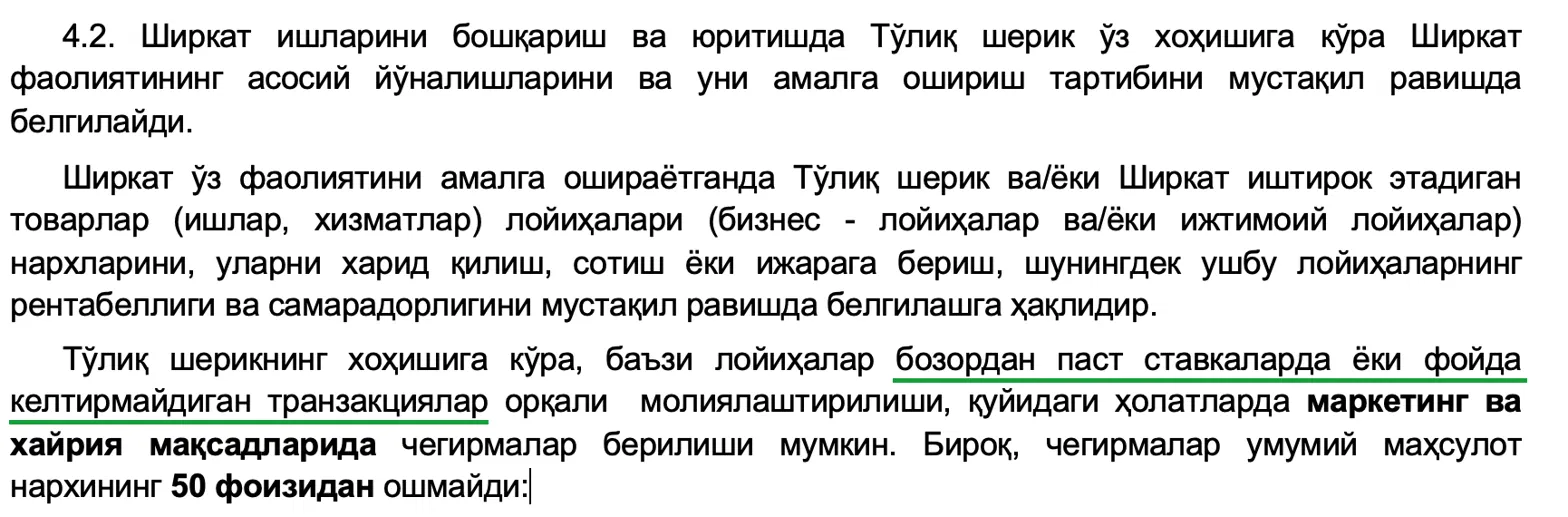
It should also be noted that the support between the companies was not one-sided: the management company also supported the fund for a long time. For example, no royalties were charged for use of the platform, and preferential rates, unprofitable for the management company itself, were introduced to attract new investors.
After its audit, the Audit Commission recognised that lending fund money to the management company was wrong; the practice was stopped entirely in July, and these funds are now secured by IMAN Holding shares. The outstanding debts will be fully repaid to the fund within 6 months starting in November. We will report on the repayment as it progresses.
3. Revenue recognition and dividends
Objection by IFCB LLC:
Revenue is recognised before the cash is received, and dividends are paid on that basis.
Profit (margin) on BNPL transactions is used as the basis for calculating monthly dividends as soon as it is recognised, before the customer has actually paid; in other words, it was found that investors were paid dividends out of cash not yet received.
Our response:
Since July, the company has kept its accounts under IFRS (International Financial Reporting Standards). Earlier periods were kept under Uzbekistan’s national accounting standards; since its founding, the company has made sales totalling UZS 2,041,153,833,796.
Under those standards, instalment contracts were of two types: murabaha and financial lease. For murabaha, these standards recognise expenses (including taxes) and revenue in the same month as the sale.
For financial leases, revenue is recognised month by month. In addition, a reserve for risks that may arise in the future is built from the profit recognised each month. These reserves are managed by the company’s risk and finance departments. This reserve is called the IRR reserve (Investment Risk Reserve, a reserve protecting investments against risk).
To date, 285,952 contracts have been signed in total, of which 195,061 are active.
Of these:
- Financial lease: 45,161 contracts, of which 11,252 are active and will generate income in the future.
- Murabaha (sale and purchase): 240,791 contracts, of which 183,809 are active and will generate income in the future.
These contracts make up an instalment sales portfolio of UZS 1,105,778,629,924; compared with the investors’ portfolio (UZS 965,024,883,309), the difference is UZS 140.75 billion.
“Personal” purchases
The video statement and published materials also allege that money was spent without justification on personal purchases. Our statement on these matters follows.
4. Mercedes-Benz S500
Objection by IFCB LLC:
Questionable transactions (possible conflict of interest).
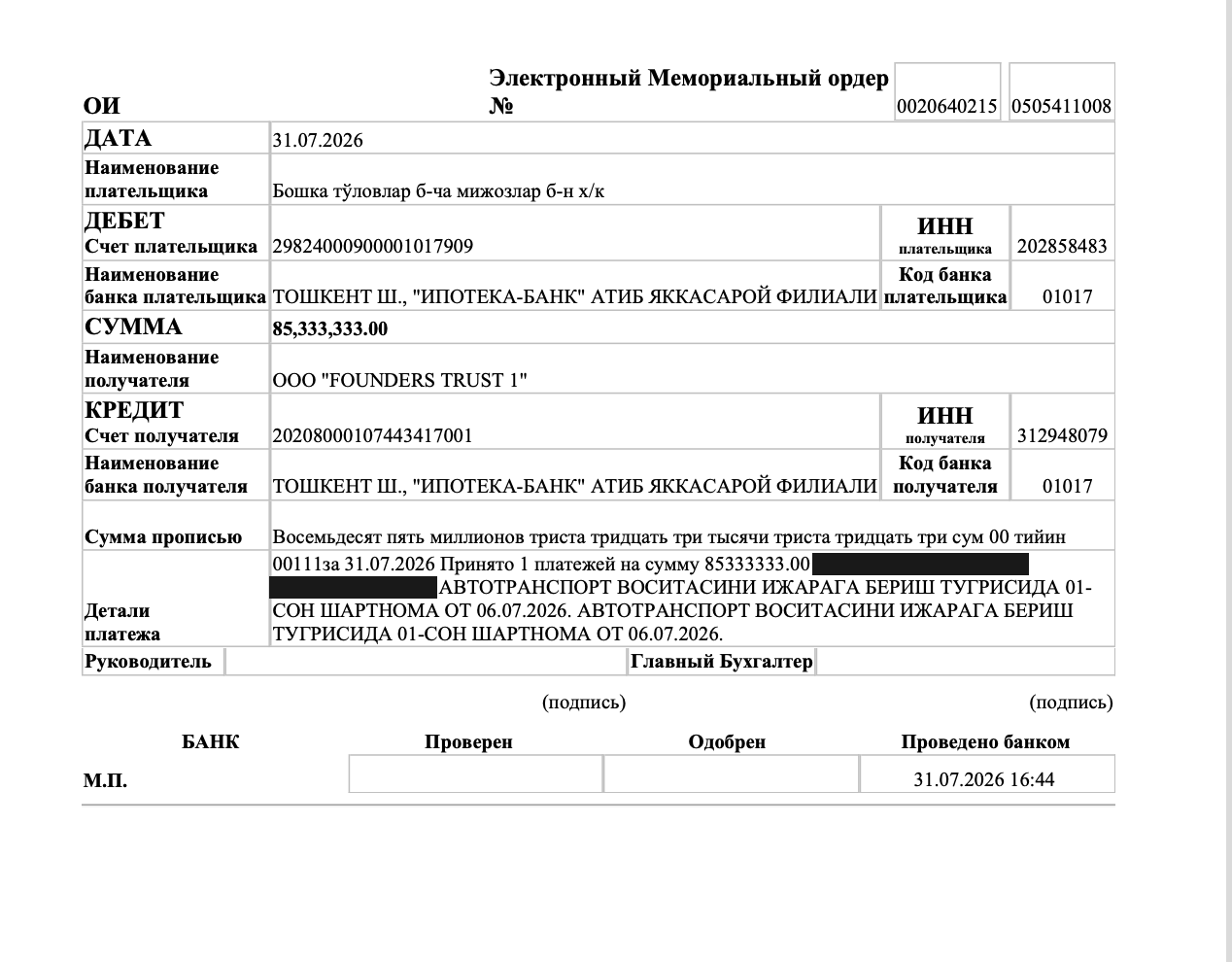
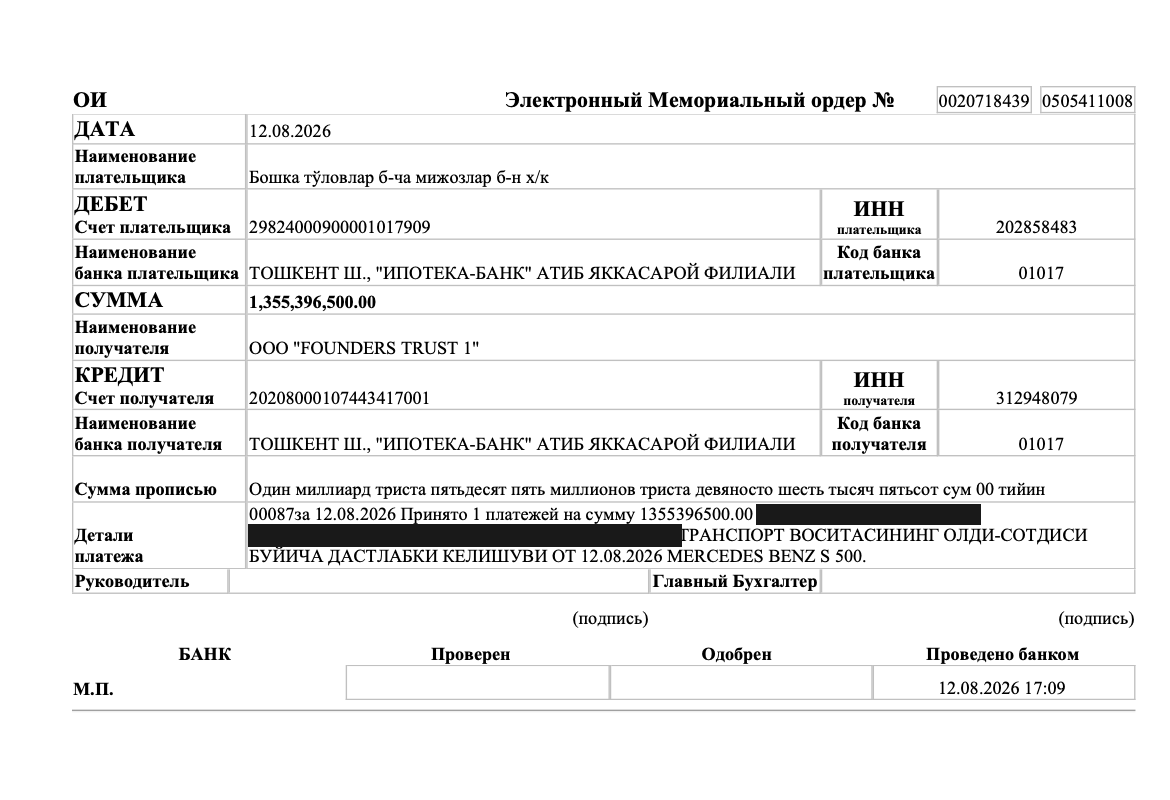
On 10 April 2026, USD 128,000 of investors’ money was transferred from the Limited Partnership’s account to the account of «FOUNDERS TRUST 1» LLC under a consortium agreement that had been signed one day before the payment, on 9 April 2026. The amount is close to the market price of a Mercedes S500. The founder and head of this LLC is an employee of the Company. It was found that this money was used to buy a car for the Company’s founder, Rustam Rakhmatov.
Our response:
On 10 April 2026, on Rustam Rakhmatov’s initiative, money from the fund was transferred under a consortium (investment) agreement to the account of «FOUNDERS TRUST 1» LLC to purchase a car. This company was set up to finance purchases on preferential terms (with discounts) for the most active employees (loyal, hard-working employees who hold a stake in the company). The car was bought through this company, and the main purpose was business needs. The plan was to buy it in the fund’s name and lease it to Rustam Rakhmatov at a market rate (a 12% mark-up in US dollars).
The transaction was made under clause 4.2 of the public offer of 28 January 2025, then in force. That clause allowed the partnership in certain cases to provide financing below market rates, for example to finance employees’ large purchases such as a home or a car on a murabaha or financial lease basis. The car’s purchase price matched its market price.
Representatives of the advisory board stated that this structure was incorrect, because the benefit under clause 4.2 of the offer is intended only for the company’s employees, not its shareholders or executives, and a shareholder is not regarded as an employee. Rustam Rakhmatov, however, worked at the company both as an employee and as its owner. Nevertheless, the transaction was deemed impermissible and closed in full; in addition, the agreed rate (12% a year in US dollars) was not approved and was reset to a rate above the market average (17% a year in US dollars). The car was sold on 12 August 2026, and the purchase amount and the lease payments for the period of use were repaid in full; the clause allowing below-market financing was also removed from the offer.
The money spent on the purchase has therefore been repaid in full, and this matter is closed.
Supporting documents:
5. BYD Champion
Objection in Audit Commission decision No. 1 (issue 2):
It was found that the company’s founder, R. Rakhmatov, bought a «BYD Champion» car under a sale and purchase agreement with instalment payment concluded on 1 December 2023. Under the agreement, the car’s cash price was UZS 420,000,000 (four hundred and twenty million), and because payment was spread over 36 (thirty-six) months, the total contract value was set at UZS 555,138,702 (five hundred and fifty-five million, one hundred and thirty-eight thousand, seven hundred and two). An advance payment of UZS 120,000,000 (one hundred and twenty million) was made when the agreement was signed.
The last payment under the agreement was made on 4 May 2025, after which payments stopped completely. The review found that collection of payments under the agreement had stopped because of a technical error and the inattention of the treasurer and R. Rakhmatov (lack of proper control over payments). As a result, for more than a year, payments that should have reached the Limited Partnership and been distributed to investors were not made, and investors were deprived of the corresponding profit (income).
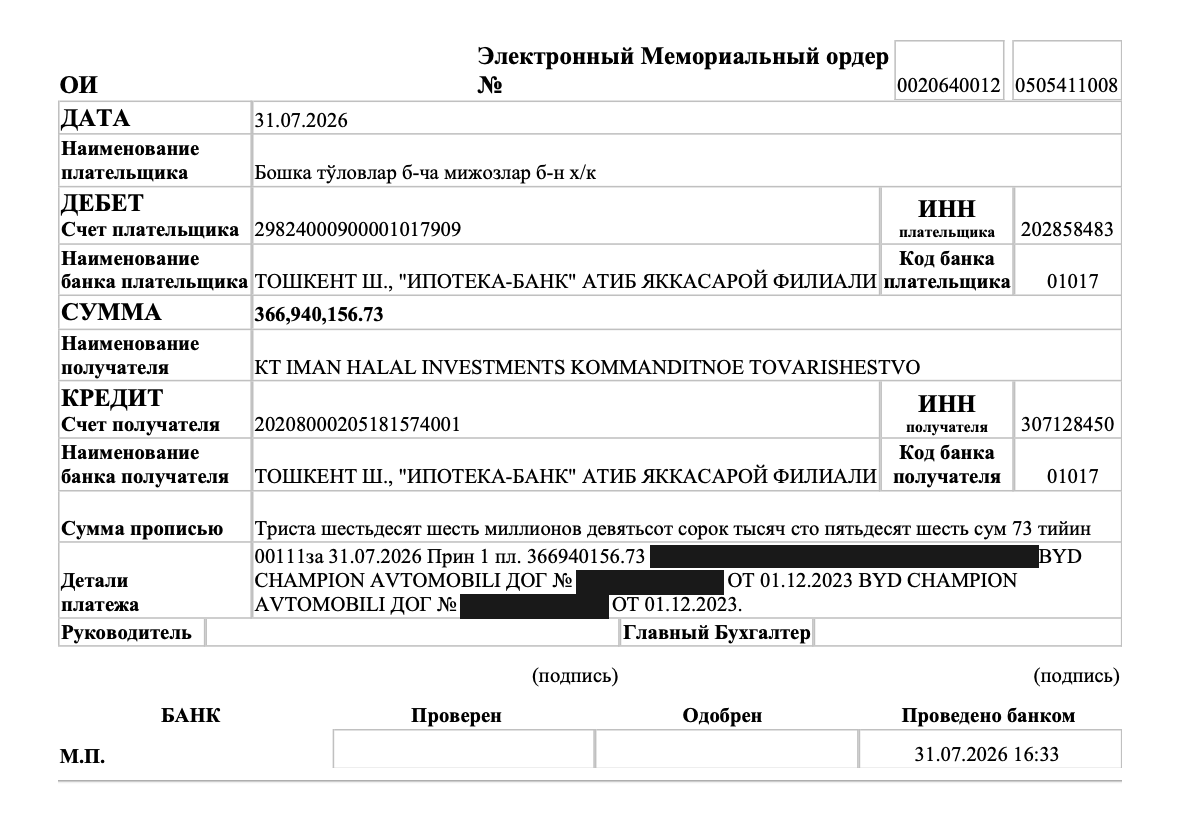
As of the date of this decision, overdue payments amount to UZS 306,504,224.73; the total debt payable by the end of the agreement on 5 December 2026 is UZS 366,940,156.73.
Our response:
On 1 December 2023, Rustam Rakhmatov bought a BYD Champion under a 36-month instalment agreement. At the time, this type of agreement was being piloted for the first time, with Rustam Rakhmatov.
During its internal review, the Audit Commission set up by the company found a delay in the payment schedule under this agreement.
Following the commission’s decision, on 31 July 2026 Rustam Rakhmatov repaid early and in full the entire remaining debt under the agreement, UZS 366,940,156.73. The money went directly to the fund’s account, and the agreement is fully closed.
Supporting documents:
Other objections in the statement
6. Fund expenses and management expenses
Objection by IFCB LLC:
Dividends paid to investors have fallen sharply because expenses relating to the Management Company’s activities were included in the Limited Partnership’s expenses. The expenses classified as “operating expenses of the Limited Partnership” include salaries averaging USD 300,000 a month, marketing of up to USD 124,000 a month, scoring, transaction fees and more.
Under Article 29 of the Law “On Business Partnerships”, the duty to manage the Limited Partnership belongs to the LLC (the General Partner). Management means that the LLC manages it with its own staff and at its own expense. This covers all functions such as making investment decisions, administering the fund, compliance and control. Therefore, registering management staff (personnel performing these functions) under the Limited Partnership and covering their salaries from the Limited Partnership’s fund contradicts the very essence of the management duty set out in Article 29 of the Law.
Furthermore, neither the Founding Agreement nor the Public Offer concluded with investors provides for such expenses to be borne by the Limited Partnership. There is therefore no basis for covering the costs of staff performing the management function at the Limited Partnership’s expense.
Our response:
Article 29 of the Law “On Business Partnerships” establishes that a limited partnership is managed by its general partners, but it does not require management expenses to be covered at the general partner’s own expense. How expenses are allocated is determined by the founding agreement and the public offer.
Expenses related to the fund’s activities have been run on a Mudaraba basis and fall into two types.
- Sales-related expenses (direct): salaries and bonuses of sales staff, salaries and bonuses of collections staff, bonuses and joint marketing costs for partner stores, performance marketing (spending aimed directly at acquiring customers), and scoring and collection costs. These expenses are directly linked to instalment and investment contracts, so they count as fund expenses.
- Management-related expenses (indirect): software development (IT), building scoring models (risk management), the finance and marketing teams, brand management and event costs. These are the management company’s responsibility and must be covered solely by the management company.
Previously, expenses related to investment contracts were treated as sales (invest sales) and covered directly by the fund. After IFCB LLC, based on its audit decision, pointed out that this was incorrect, it was decided that expenses must be transparently split between instalment contracts and investment contracts. Work in this direction is under way. These processes will be corrected within 3 months starting in November.
7. Expenses found to be unrelated to the fund
Objection by IFCB LLC:
More than 60 percent of total expenses were spent on activities and products not directly related to the Limited Partnership’s activities.
For example, USD 144,000 was spent on the Imanum 5.0 launch ceremony and USD 187,000 on private banking. Such expenses relate to developing the Management Company’s brand, marketing and non-core areas, and do not fall directly within the Limited Partnership’s activities of raising and managing investors’ funds.
Our response:
IMANUM 5.0 was an event held on 18 June 2026 at which the holding’s new services were presented.
The event’s total cost was UZS 833,122,120 (about USD 70,000). Of this, only UZS 40,020,000 (about USD 3,400, or 4.8%), the cost of advertising the app, was paid by the fund; the remaining UZS 793,102,120 was covered entirely by the management company. Investors put money into the fund through this very app, and customers use its instalment service, so the part paid by the fund counts as a sales expense.
Private banking expenses relate to serving investors. Because these investors are brought specifically into the fund, it was initially intended that these expenses would be covered by the fund. After a joint review with IFCB LLC, it was decided that these expenses belong to the management company.
This amount is therefore being formalised as a sale under a Murabaha contract: the fund finances the purchase for the management company, and the management company buys it in instalments over 24 months at the average market mark-up (20% a year). In other words, the matter has been fully resolved.
8. IRR reserve
Objection by IFCB LLC:
Topping up the «IRR» reserve fund beyond the limit set in the agreement artificially reduces investors’ current dividends.
Under the investor agreement, no more than 5 percent of distributable income may be directed to reserves. In practice, however, about 23 percent of income in May and about 50 percent in June was withheld to top up the IRR reserve.
Our response:
In May and June 2026, allocations to the IRR reserve exceeded the 5% limit set in the agreement. This was a mistake made by an employee with authority to take finance and risk decisions, without the knowledge of the company’s management and the Sharia board. The aim was to fill the IRR reserve (the reserve protecting against risk) faster for the future. We parted ways with this employee at the beginning of August.
Since July, the company has made allocations within the 5% limit set in the agreement, and it has been decided that this will not happen again.
Conclusion
Current status of the issues identified in July:
- In July, finance and accounting moved to international standards, and UZS 140 billion of profit expected in the future was identified.
- In October, the 3% intercompany transactions were secured by Holding shares.
- During July and August, 2 car lease agreements were fully closed on the basis of a Sharia opinion that, from an Islamic finance standpoint, they are impermissible for the business owner, and the money was returned to the fund together with the lease payments.
- In July, the practice of lending fund money to the management company and covering management expenses from the fund was stopped.
- In July, allocations to the IRR reserve were brought back within the agreement.
Next steps:
- Rustam Rakhmatov will announce the handover of management to experienced professionals and will continue as a member of the Supervisory Board. The chair and members of the Supervisory Board will be announced in the coming days.
- The company has decided to form a Sharia Board of 3 scholars. It has also signed an agreement with the international audit firm Usmani’s and begun an external Sharia audit. Work has also begun on engaging international independent financial auditors. Once the audit is complete, the results will be published in full.
- A decision has been made to fully register the Holding’s shareholders and the investors who joined under SAFE agreements; this will be done within 1 month.
Sincerely, IMAN Holding Supervisory Board